Africa's insurance gap is a distribution and trust problem, not a product problem
A bad insurance pitch often sounds reasonable.
“Low premium.” “Simple cover.” “Built for the mass market.”
Then nothing happens. The brochure is clear. The pricing is not absurd. The need is obvious. Yet take-up stays thin, renewal is weak, and claims stories travel faster than product updates.
My claim is simple.
The gap is distribution and trust
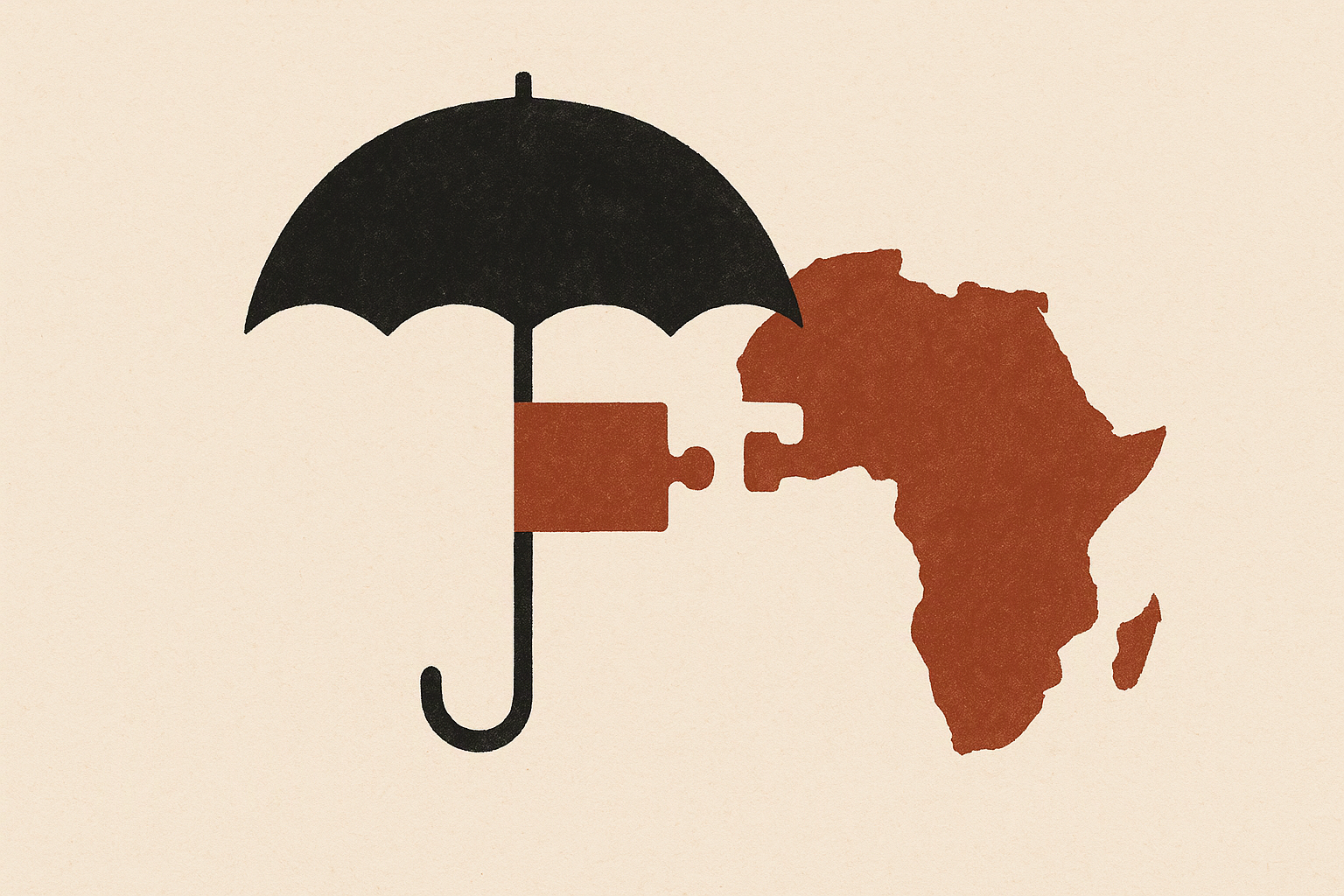
Africa’s insurance gap is mainly a distribution and trust problem, not a product problem.
I do not mean product does not matter. It does. Bad exclusions, confusing wording, poor pricing, and useless claims processes can kill adoption. But if I start from first principles, the bigger constraint is earlier in the chain. Most people do not buy insurance because they do not encounter it inside trusted routines, and when they do encounter it, they do not believe the promise will hold at the moment of claim.
That is a distribution problem first. Then a trust problem immediately after.
The easiest way to see this is to ask a blunt question: what must be true for insurance to work for a household or small business with volatile income?
Three things.
First, the customer has to be reached cheaply and repeatedly. Not once. Repeatedly. Insurance is sold against present bias. People pay now for a contingent future event that may never happen. That is a hard sell even in rich markets. It is harder when income is irregular and there are many more urgent uses for cash.
Second, premium collection has to fit real cash flow. Monthly direct debit is a product feature in some markets, but it is really a distribution capability. If the payment rail does not match how money moves, the policy lapses.
Third, claims have to feel real before the loss happens. This is trust. If people believe the insurer will dodge, delay, or disappear, the expected value of the product collapses in their minds, even if the actuarial value on paper is fair.
Most insurance startups attack the third-order question first. They tweak benefit design. They rename the policy. They wrap old cover in a new app. They call this innovation. It usually is not.
Insurance is bought where life already happens
Distribution is not a marketing channel. It is the set of places where financial behavior already occurs.
That is why embedded insurance keeps reappearing as the practical answer. Not because “embedded” is fashionable, but because it aligns with how people actually transact. If someone already pays a hospital, a school, a cooperative, a mobile operator, a lender, a payroll provider, or an agriculture input dealer, that touchpoint has three advantages an insurer alone does not.
It has attention.
It has payment flow.
It may have trust.
That last word matters most. Trust is not created by branding spend. It is borrowed from institutions that already have a right to ask for money and a duty to show up after the fact.
I made a related argument in Informal-sector micro-insurance group enrollment for Nigeria co-ops: if you want micro-insurance to work in Nigeria’s informal sector, group enrollment should be built around contribution flows, claims proof, and trust, not apps. That logic generalizes. Insurance succeeds when it rides on existing contribution behavior and trusted intermediaries, not when it asks people to adopt a new standalone habit.
This is also why the broad lesson from software applies here. In The biggest moat in AI products will be distribution inside existing workflows, not proprietary models or benchmark wins, I argued that the durable edge comes from being embedded where work already happens. Insurance is harsher. The product is invisible until something goes wrong. So workflow distribution matters even more.
A football coach would recognize the pattern. If a team cannot receive the ball cleanly in midfield, drawing better finishing patterns on the whiteboard will not rescue the attack. Product redesign is the whiteboard. Distribution is midfield progression. You need the ball in dangerous areas first.
Product innovation is overrated here
If Africa’s insurance problem were mostly a product problem, we would expect a new wave of highly tailored products to have broken through on their own.
Some have not.
That does not mean they were bad ideas. It means a narrowly improved insurance product still has to cross the same old chasm: how do you explain it cheaply, collect premiums reliably, and make claims credible?
Take health, life, device, crop, and hospital cash products. The menu already exists. There is no shortage of theoretical cover types. The real shortage is dependable pathways from distribution to enrollment to premium collection to claims payout.
This is one reason payments matter so much. Real-time payment systems change insurance economics because they reduce collection friction and can make payout speed visible. I wrote about that in UPI, Pix, and NIBSS: Insurance in Real-Time. But even here, it is easy to overstate what payments alone can solve. Better rails help. They do not manufacture trust from thin air.
A customer who receives a claim instantly will tell ten people. A customer who pays for twelve months and is denied on a technicality will also tell ten people. In many communities, the second story travels faster.
So the binding constraint is not just premium affordability. It is whether a believable social proof loop forms around claims.
India and Brazil show what can and cannot be copied
Cross-market comparisons help because they force discipline.
India’s UPI is useful here, not because India has solved insurance, but because it shows what happens when digital payment acceptance becomes normal at mass scale. If money can move cheaply and instantly, insurers and distributors can match premium collection to actual behavior with much less friction. But UPI itself does not guarantee insurance adoption. India also has dense institutional layers: banks, state schemes, employer links, and a regulatory apparatus with very specific local history. You can copy the rail more easily than you can copy the surrounding trust architecture.
Brazil’s Pix teaches a similar lesson. Instant payments can sharply improve the operating model for insurers and distributors. Collection gets easier. Payouts can get faster. Reconciliation improves. But Pix does not abolish the need for a trusted distributor or a fair claims reputation. It improves the plumbing. Plumbing matters. Plumbing is not the whole house.
China is the strongest counterexample to any simplistic “just embed it” thesis. China’s large platforms proved that financial products can scale fast when embedded into dominant consumer ecosystems. But much of that depended on platform concentration, smartphone behavior, merchant acceptance, and state capacity that are not straightforward to reproduce elsewhere. Africa can learn from the principle of embedding into high-frequency transactions. It cannot assume the same platform leverage exists market by market.
Southeast Asia is instructive for another reason: distribution can be fragmented but still effective if insurers ride through wallets, super apps, ride-hailing ecosystems, and e-commerce flows. Again, the common factor is not exotic product design. It is distribution through trusted, repeated activity.
The US and Europe, for all their insurance maturity, are reminders that wealth alone does not solve trust. These markets have far deeper insurance penetration, but they also have endless complaints about opaque exclusions, claim denials, and broker incentives. The lesson is not that Africa should import their products. The lesson is that mature markets still wrestle with trust, even after solving for distribution. Africa has to solve both with fewer institutional buffers.
The right wedge is not “insurance first”
If I were pressure-testing a new insurance company or MGA thesis in an African market, I would be skeptical of “we built a better policy” as the lead wedge.
I would look instead for one of four things.
A distributor with an existing payment relationship.
A group structure with social enforcement and claims verification.
A context where the risk event is legible and frequent enough to make the product understandable.
A claims experience that can be demonstrated quickly and publicly.
That is why cooperatives, payroll systems, lenders, hospitals, schools, and mobile-linked channels matter so much. They are not just customer acquisition channels. They are verification systems. They are payment systems. They are trust transfer systems.
The most promising models may look less like insurance brands and more like care coordinators, payroll services, or financial operating systems that happen to include insurance. That is one reason I found the logic in CareBridge: diaspora-funded care coordination for family in Nigeria compelling. Start with the trusted operational problem. Add insurance where it closes a loop. Do not begin with the policy as the hero.
Trust is built at claim time
Trust in insurance is strange. It is usually sold in advance and evaluated in arrears.
That makes claims the central product, even when the policy document gets all the design attention.
So when I say the problem is trust, I mean very specific things: proof requirements the customer can actually satisfy; payout timing that matches distress; call center behavior that does not sound evasive; denial logic that can be explained in plain language; and visible evidence that legitimate claims are paid.
This operational layer is where many insurers lose the plot. A policy can be simple on paper and still untrustworthy in practice.
That is not a branding failure. It is a systems failure.
My confidence is medium
Medium confidence.
The direction of the claim feels strong to me. In market after market, insurance scales when it is attached to trusted distribution and visible claims performance, not when it is merely redesigned as a standalone product.
My confidence is not high because “Africa” is too broad for any universal statement. South Africa is not Nigeria. Kenya is not Egypt. Regulatory structures, mobile money penetration, bank reach, employer formality, health system capacity, and distributor incentives vary sharply. Some sub-markets may still have genuine product gaps that matter more than I am giving them credit for.
I am also deliberately not asserting a single statistic here because I would want to verify several figures before using them. [[clear: verify recent insurance penetration and density data by major African markets from official regulators or Swiss Re sigma]]
What would change my mind
I would change my mind if I saw repeated evidence of this pattern:
A standalone insurer with no privileged distribution channel and no pre-existing trust intermediary launches a meaningfully new product, acquires customers efficiently, sustains renewals, and earns strong claims satisfaction across multiple African markets.
Not one campaign. Not one subsidized pilot. A repeated result.
Or a second test.
If two insurers sell through the same distributor to a similar customer base, with similar claims performance and collection mechanics, and the one with the better product design consistently and materially outperforms the other, then product would deserve more weight in my model.
Those are falsifiable tests.
Until then, my working principle is plain: insurance adoption follows trusted money movement and credible claims, not clever policy wording. The open question is which institutions in each market have earned the right to carry that promise.
Sources
- https://web.archive.org/web/20261024210736/https://www.npci.org.in/what-we-do/upi/product-overview
- https://www.bcb.gov.br/en/financialstability/pix_en
- https://www.swissre.com/institute/research/sigma-research.html