Informal-sector micro-insurance group enrollment for Nigeria co-ops
I keep coming back to a simple scene.
A market traders’ co-op meets on a Saturday. Names are called. Contributions are counted. Someone is absent, and another member explains why. A loan request comes up. A burial levy is discussed. The ledger is not elegant, but it is alive. It contains social facts. Who pays. Who misses. Who can be trusted. Who needs help.
That is closer to an underwriting system than most insurance product decks admit.
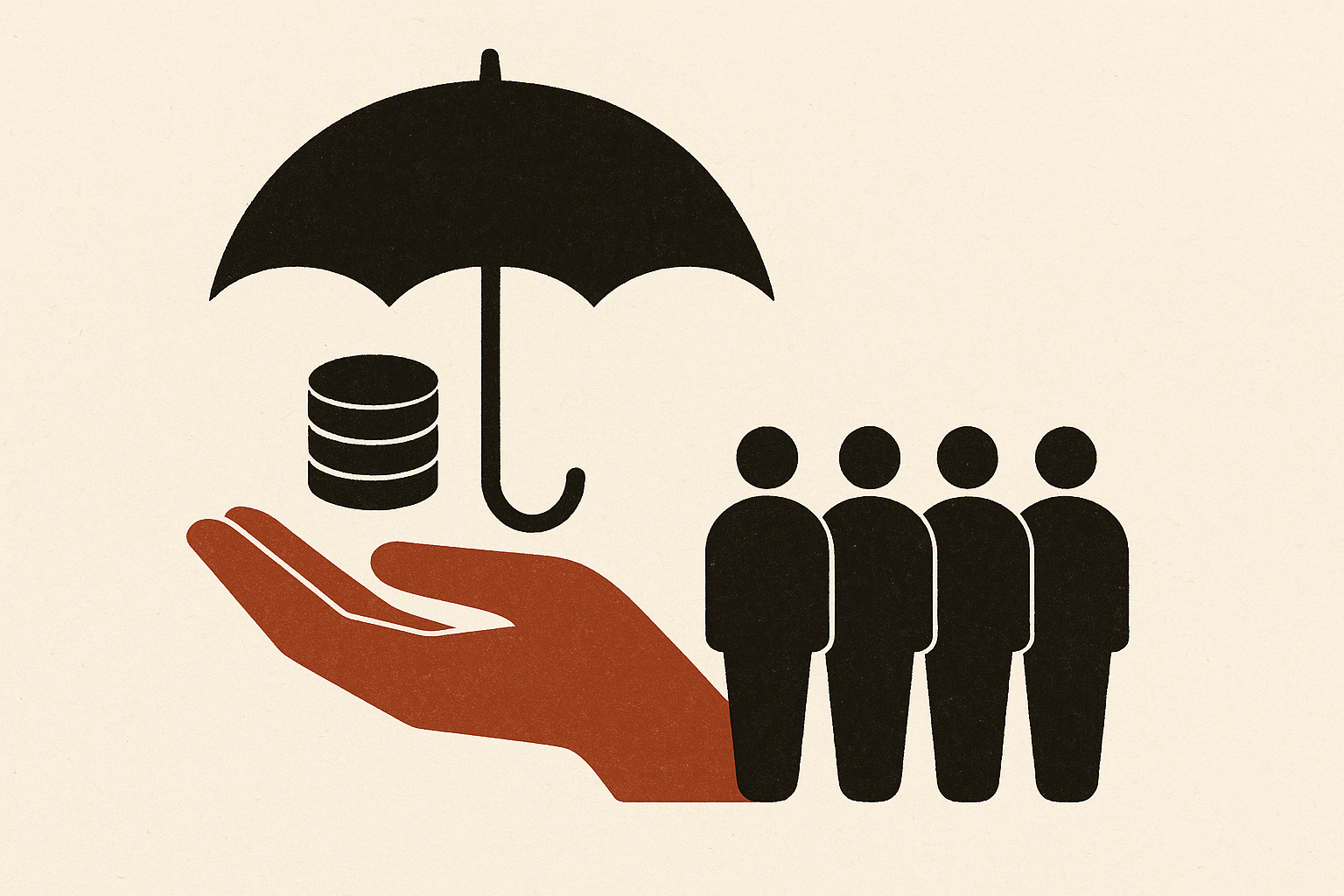
My claim: informal-sector micro-insurance in Nigeria will scale through co-op enrollment only when the co-op is treated as the operating system for distribution, payment collection, and first-mile claims evidence.
Not as a marketing channel. Not as a convenient group discount. As the actual machinery.
This sounds obvious. It is not. Many “inclusive insurance” efforts still behave as if the hard problem is premium price or app access. I think the harder problem is operational fit. Insurance fails in the informal economy when it asks households with volatile cash flow to behave like salaried policyholders, and when it asks insurers to trust thin individual records without using the dense social records already present in co-ops, thrift groups, trade associations, and unions.
The unit is the group
From first principles, insurance needs four things to work.
A defined pool. A way to collect money. A way to verify covered events. A reason to believe claims will be paid fairly.
The informal sector struggles on all four when approached one individual at a time.
Income is irregular. Addresses shift. Phone numbers change. Formal records are thin. Trust is low, and usually earned locally rather than institutionally. That makes CAC-style direct acquisition or app-led self-serve enrollment a poor fit for many segments, especially outside already-digitized urban workers.
But co-ops already solve parts of this.
They maintain membership boundaries. They run recurring collections. They police non-payment with social rather than legal enforcement. They often know enough about members’ households and livelihoods to establish basic facts quickly. That does not replace formal insurance processes. It lowers the cost of the first mile.
This is the same broad lesson I argued in UPI, Pix, and NIBSS: Insurance in Real-Time: payments infrastructure changes insurance when it changes operating cadence, not just checkout convenience. For co-op insurance in Nigeria, the relevant question is not “can members pay digitally?” It is “can premiums follow the same rhythm and exception handling as existing contribution flows?”
Those are different questions.
Collection beats sign-up
If I had to choose one metric to obsess over, it would not be total enrollments. It would be 6-month premium persistence.
Enrollment drives headlines. Collection drives insurance.
A co-op leader can sign up 300 members in a launch meeting. That proves almost nothing. The real test is whether those members can keep paying through bad weeks, seasonal dips, school fees, fuel shocks, and health emergencies. In the informal economy, premium failure is often a cash flow design failure disguised as lack of awareness.
Nigeria has useful rails here. NIBSS Instant Payment and the rise of account-based transfers make recurring and traceable payments more feasible than in the past, even if the experience is still uneven across institutions and user segments. But digital rails do not remove the need for a collector logic. They just give it better plumbing.
India’s lesson with UPI is relevant but easy to over-copy. UPI dramatically improved low-cost digital payment acceptance and pull/collect flows around bank accounts and apps, but it sits on a broader stack: bank-linked identity, widespread PSP participation, and a very specific combination of public digital infrastructure. Nigeria can learn from the principle, make payment collection cheap, immediate, and interoperable, but cannot simply import the conditions.
Brazil’s Pix teaches something slightly different. Pix did not just digitize payment. It changed user expectation around immediacy and availability. For insurance, that matters at claims time as much as premium time. A policyholder who receives a small approved payout instantly experiences the product differently from one told to wait days. Again, the principle transfers. The exact adoption path does not.
China and parts of Southeast Asia offer a further warning. Embedded insurance can grow fast when tied to giant platforms with dense behavioral data and daily transaction frequency. Many Nigerian co-ops do have recurring transactions and trust networks, but they are fragmented, offline-heavy, and governed by local human relationships. You cannot copy platform-scale underwriting assumptions into a federation of market associations and expect the same loss ratios or retention.
Claims are where trust lives
Insurance is not bought at enrollment. It is bought at first claim.
This is especially true in Nigeria, where skepticism toward financial promises is rational. For many informal workers, the prior is simple: if the institution is distant, the claim may become a fight.
That is why co-op-led first-mile claims handling matters so much. Not adjudication. Evidence.
If a member is hospitalized, who can confirm that quickly? If a petty trader loses inventory in a market fire, who can attest she was an active trader in that location? If a funeral benefit is triggered, who already knows the household and can gather the death documentation or community proof that starts the process?
In many cases, it is the co-op secretary or chair.
This does create risks. Local gatekeepers can exclude members unfairly. Fraud can become collusive rather than individual. A co-op officer may pressure claims triage based on status or relationships. So the design cannot be “trust the co-op blindly.” It has to be “use the co-op to gather structured evidence, then apply clear insurer rules and auditable workflows.”
That is partly a product problem and partly an operations problem. I have made a similar point in Call center compliance QA analyzer (collections and insurance): in regulated categories, the hard part is not generating text. It is mapping policy to evidence with low tolerance for silent failure. Group micro-insurance has the same shape. The valuable system is not a pretty enrollment chatbot. It is a durable workflow that records member status, contribution history, benefit eligibility, submitted evidence, exception reasons, and claims outcomes.
The notebook matters more than the script.
Product should follow co-op reality
I would start narrower than many founders want.
Not “micro-insurance for the informal sector.” Too broad. That phrase hides more than it reveals.
I would pick one co-op archetype with a clear contribution cadence and a claim type that can be verified without heroic paperwork. Market women associations. Transport unions. Artisan guilds. Savings groups with strong attendance discipline. Then I would design around events those groups already recognize as legitimate reasons for solidarity payouts: hospitalization cash, funeral support, accident cover, maybe inventory/fire cover only where verification is practical.
Health insurance in the richer, comprehensive sense is harder. The burden of provider network management, claims control, benefit clarity, and fraud management rises quickly. The trust dividend from group distribution helps, but it does not dissolve the complexity. GD and I have touched adjacent trust and coordination problems before in CareBridge: diaspora-funded care coordination for family in Nigeria. The broad lesson holds here too: the gap is rarely just payment. It is follow-through, proof, and coordination across messy real-world steps.
A football analogy fits, briefly. Youth teams do not improve because you handed out better boots. They improve when the training drills match the players in front of you, the pitch they actually use, and the habits they can repeat next week. Insurance products often fail because they are sold like better boots.
Regulation is part of the product
Micro-insurance in Nigeria is not a permissionless category. The National Insurance Commission has frameworks and licensing structures that matter, including for microinsurance institutions and distribution. I am not a lawyer, and any build here needs proper regulatory reading, not vibes.
But from a systems angle, regulation is not merely a hurdle. It can be a design constraint that improves the product.
If co-op leaders are effectively distributing, collecting, and assisting with claims, what training is required? What disclosures must be made? Who holds premium funds, and when are they swept? What happens when a member believes the co-op misrepresented benefits? Which complaints route is visible and credible? These are not back-office details. They determine whether the model survives contact with real losses.
My confidence rises when a product treats these frictions as core workflows rather than legal appendices.
I am medium confidence
Medium.
The main reason is simple: the theory is strong, but outcomes will vary sharply by co-op quality. “Co-op” is not a reliable unit of trust by itself. Some are disciplined and data-rich. Some are thin shells around a charismatic chairperson. Some have robust collections but weak governance. Some are already overburdened.
I am also uncertain about the exact economics by product line. Claims frequency, premium affordability, commissions, servicing cost, and fraud exposure need segment-specific validation. I do not want to fake precision here. [[clear: verify practical persistence and claims-ratio benchmarks for Nigerian microinsurance by product type]].
What would change my mind
A falsifiable test would change my view.
If an insurer or startup can acquire informal-sector micro-insurance customers in Nigeria one-by-one, outside co-op or employer structures, and show over 12 months that it beats a comparable co-op-led model on three things at once, premium persistence, claims turnaround, and complaint rates, I would revise this thesis.
A second test would also matter. If co-op-led enrollment produces impressive sign-up numbers but materially worse claims fairness or higher dispute rates because local gatekeepers distort access, then the group advantage may be distribution-deep but trust-shallow.
For now, I think the answer is more grounded.
In Nigeria’s informal economy, insurance works when it borrows the structure of the institutions people already use to survive volatility. The trick is not to romanticize those institutions. It is to instrument them carefully.
The open question is not whether co-ops can sell insurance. It is whether insurers can learn to underwrite the reality co-ops already see.
Sources
- https://web.archive.org/web/20261006082816/https://naicom.gov.ng/
- https://nibss-plc.com.ng/
- https://web.archive.org/web/20261024210736/https://www.npci.org.in/what-we-do/upi/product-overview
- https://www.bcb.gov.br/en/financialstability/pix_en